
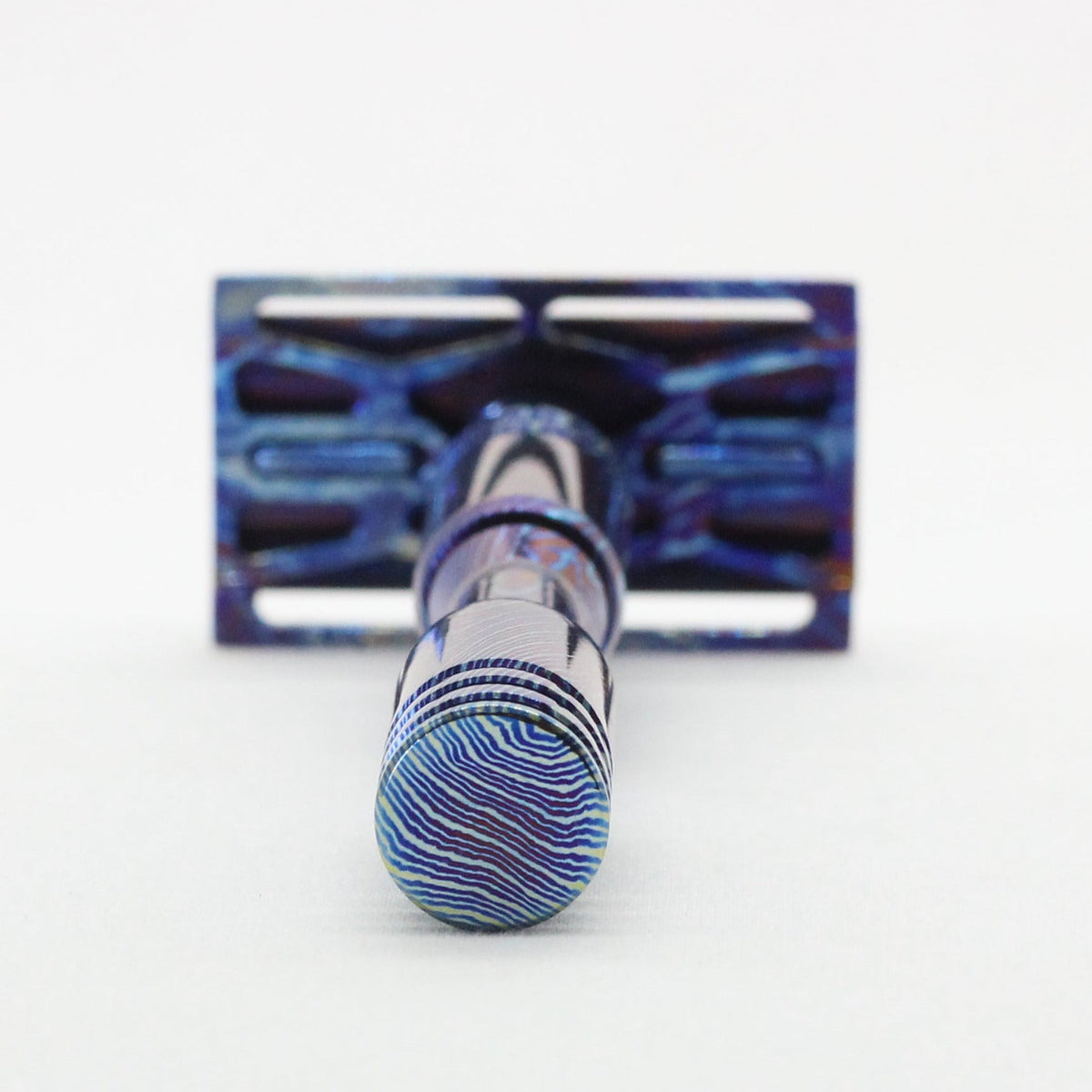
What Is Titanium Damascus? Damtanium, Timascus & Custom Safety Razors
What Is Titanium Damascus?
Titanium Damascus is a layered metal made by forge welding different titanium alloys into a single billet and manipulating those layers to create a visible pattern.
Like traditional Damascus steel and Japanese mokume-gane, its character comes from the material itself. The pattern is not printed, engraved or applied as a coating. It extends through the billet and is revealed as the material is forged, machined and finished.
At Carbon Shaving Co., we use a form of Titanium Damascus called Damtanium for some of our most distinctive custom Cx safety razors.
Our Damtanium combines Grade 2 and Grade 5 titanium. Alternating layers are joined under carefully controlled heat and pressure before the resulting billet is machined into individual razor components.
The finished material combines two characteristics that don't often appear together: the extremely low weight associated with titanium and the organic, non-repeating pattern of a forged layered metal.
Once flame anodized, those layers can also reveal striking blues, purples, golds and other colors.
No two finished pieces are exactly alike.

Carbon Cx custom safety razor featuring flame-anodized Damtanium.
What Is Damtanium?
Damtanium is the proprietary name used by Vegas Forge for the Titanium Damascus material we use at Carbon.
Our material combines layers of Grade 2 and Grade 5 titanium that are forged together to create a single patterned billet.
The name itself combines the ideas of Damascus and titanium.
The basic concept is straightforward. Different titanium alloys are layered together and permanently joined. In practice, successfully creating the material is considerably more difficult.
Titanium is highly reactive at elevated temperatures, so temperature, atmosphere, pressure and contamination must be carefully controlled during the forging process.
The exact process used to produce our Damtanium is proprietary to the forge.
What arrives at our shop is not a finished decorative surface. It is raw material that still has to be machined into the precise geometry of a Cx safety razor and then extensively hand finished before its pattern and color are fully revealed.
Why Combine Grade 2 and Grade 5 Titanium?
Grade 2 and Grade 5 titanium have different compositions and properties.
Grade 2 Titanium
Grade 2 titanium is a commercially pure titanium grade. It is lightweight, highly corrosion resistant and comparatively formable.
Those characteristics make it useful in demanding applications and also make it suitable for joining with other titanium grades during the creation of layered Titanium Damascus.
Grade 5 Titanium
Grade 5 titanium, commonly known as Ti-6Al-4V, is an alloy containing titanium, aluminum and vanadium.
It offers considerably greater strength than commercially pure titanium while maintaining titanium's excellent strength-to-weight ratio and corrosion resistance.
Grade 5 is also the titanium alloy we use for our conventional solid-titanium Cx razors....the Cx-Ti.

Why the Combination Matters
Combining different titanium alloys does more than create layers.
The different alloys respond differently during finishing and anodizing. This allows the forged pattern to become considerably more visible than it appears in the unfinished material.
That's where Titanium Damascus becomes particularly interesting.
How Is Titanium Damascus Made?
The general principle resembles other layered metals: sheets or layers of different material are assembled and then joined under heat and pressure.
With Titanium Damascus, controlling the forging environment is critical.
Titanium's behavior at elevated temperatures makes variables such as temperature, pressure, oxygen and atmosphere particularly important.
Once the layers have been successfully bonded into a billet, the material can be further forged and manipulated to develop its pattern.
Those layers continue through the material.
When we later machine a top cap or other Cx component from the billet, removing material exposes different portions of the forged layers underneath.
Much like mokume-gane, you don't completely know what the finished component will look like until you begin cutting into the material.

Raw Titanium Damascus material. The forged layers extend throughout the material.
Damtanium vs. Timascus: What's the Difference?
The terms Titanium Damascus, Timascus, Damtanium, MokuTi and TiMoku are sometimes used as though they all describe exactly the same thing.
They don't.
Titanium Damascus is the useful general description for layered patterned titanium made from multiple titanium alloys.
Timascus is the trade name associated with a particular patented form of Titanium Damascus developed in the United States.
Damtanium is the proprietary name Vegas Forge uses for the Titanium Damascus material we use at Carbon.
Names such as MokuTi and TiMoku have also been used for other forms of patterned layered titanium.
They share a general concept—joining different titanium alloys to produce a patterned material, but the names should not automatically be treated as interchangeable descriptions of the same manufacturer's material or process.
For that reason, I refer to the material used in our custom Cx razors as Damtanium or Titanium Damascus, rather than Timascus.
What Does Titanium Damascus Look Like Before Anodizing?
Surprisingly subtle.
A highly polished piece of unfinished Titanium Damascus does not necessarily display the vivid blue, purple and gold colors most people associate with the material.
Before flame anodizing, the forged layers can appear as subtle variations within the polished silver-gray titanium.
On some of our pieces, I've described the appearance as almost tiger-shark-like, faint flowing markings visible underneath the polished surface.
The pattern is already there.
Color simply reveals it in an entirely different way.

Polished Damtanium before flame anodizing. The layered pattern is present but considerably more subtle.
Why Does Titanium Damascus Turn Blue, Purple and Gold?
This is one of the most fascinating characteristics of titanium.
The colors are not paint, dye or pigment.
When titanium is heated or anodized, a transparent titanium-oxide layer forms on its surface. As the thickness of that oxide layer changes, light interacts with the surface differently.
The result is visible color.
Different oxide thicknesses can produce shades of gold, purple, blue, green and other colors.
Because Damtanium contains different titanium alloys in distinct forged layers, those layers can respond differently during the process.
The result is the dramatic flowing pattern associated with finished Titanium Damascus.
Flame Anodizing Damtanium
For our custom Damtanium razors, I first bring the components to a high-polish finish.
That preparation is important because the condition of the surface influences the appearance of the finished piece. I then clean the parts thoroughly, Like Mokume, as even oil from your fingerprint will change the finish.
I then use a flame to heat-anodize the titanium.
This is one of my favorite stages of working with the material because the appearance can change very quickly. The trick is to know when to stop flaiming the parts.
The relatively subdued polished layers begin developing color, starting with gold and then blue and the forged pattern suddenly becomes much more pronounced.
Temperature and technique affect the colors that emerge, so the process also introduces an element of unpredictability.
I can influence the result.
I cannot make two pieces perfectly identical.
And with a material like Damtanium, I don't want to.
Flame anodizing changes the thickness of the titanium oxide layer, revealing color and increasing contrast between the forged layers.
Machining Titanium Damascus
Creating the billet is only part of the challenge.
Machining Damtanium into a precision safety-razor component presents its own difficulties.
The billet contains different titanium grades with different material characteristics. Cutting through those alternating layers can be demanding on tooling, and titanium itself requires careful control of cutting conditions. Titanium Damascus is machined slower then our regular titanium Cx razors because of this.
That matters because the finished object still has to function as a precision Cx component.

The visual pattern can vary.
The functional geometry cannot.
Blade location, clamping surfaces and the geometry that determines the shave still have to meet the same requirements as our conventional Cx components.
That intersection, an unpredictable artistic material machined into a controlled mechanical object, is one of the reasons I enjoy working with Damtanium.
Is Titanium Damascus Heavy?
No.
One of the most unusual characteristics of Titanium Damascus is that it creates the appearance and individuality we associate with exotic layered metals without giving up titanium's low density.
That creates a very different experience from a copper-rich mokume-gane razor or stainless steel Damascus.
Mokume and stainless damascus can feel dense and substantial.
Damtanium retains the distinctly lightweight feel of titanium.
For someone who appreciates unusual materials but prefers a lighter razor, Titanium Damascus offers an interesting combination: visual complexity without the mass associated with many other decorative metals.
Does Flame-Anodized Titanium Damascus Change Over Time?
Yes.
The colored surface of flame-anodized titanium can change through handling and use.
Because the color results from the oxide layer at the surface rather than pigment within the metal, wear can gradually alter its appearance.
I don't necessarily consider that a disadvantage.
Like the patina on mokume-gane, it gives the material an opportunity to develop character through ownership.

The finish can also be refreshed or the material can simply be allowed to age to show the wear over time.
A custom razor does not necessarily have to remain visually frozen in the exact condition in which it left my shop.
Titanium Damascus vs. Mokume-Gane
Titanium Damascus and mokume-gane are visually related because both use layers of different metals to create organic patterns, but they are very different materials.
Mokume-gane traditionally combines contrasting non-ferrous metals and is particularly known for patterns resembling wood grain. Copper-rich mokume also develops a natural patina and has substantial weight.
Damtanium combines different titanium alloys. It is much lighter and can produce vivid colors through anodizing.
Both materials give me something conventional homogeneous metal cannot:
Controlled geometry with an uncontrolled pattern.
If you want to understand mokume-gane in greater detail, I have a separate guide covering its Japanese origins, how it is forged and how we use it in custom Cx razors.
What Is Mokume-Gane? The Japanese Metalworking Art Behind Our Custom Safety Razors →
Titanium Damascus vs. Stainless Damascus
Titanium Damascus and stainless steel Damascus share a similar idea: both use layers of different metals or alloys that are forged together to create a pattern that extends through the material. But the finished materials are very different in appearance, weight and the way their patterns are revealed.
Our stainless steel Damascus takes a different approach. Rather than using anodized color to reveal the pattern, the contrasting stainless steel layers are brought out through etching. The result is typically more monochromatic in terms of colors—silvers, grays and darker tones—with the etched forged pattern itself providing the visual character.
The difference is also immediately noticeable in the hand. Stainless Damascus has the heavier, more substantial feel of stainless steel, while Damtanium remains remarkably light for such a visually complex material.
Damtanium is lighter, more colorful and more visually dramatic. Stainless Damascus is heavier, more restrained and has a more traditional etched, forged-steel appearance.
Neither changes the fundamental Cx shaving geometry. The material changes the weight, appearance and feel of the razor; the selected Cx base plate and head geometry determine how it shaves.
If you prefer the heavier, more traditional appearance of layered steel, you can learn more about how we use stainless Damascus in our separate guide.
Explore Stainless Damascus and Carbon Custom Razors →
Frequently Asked Questions About Titanium Damascus
Is Titanium Damascus Real Damascus?
Titanium Damascus is not traditional Damascus steel.
The term describes a layered titanium material produced by joining different titanium alloys to create a patterned billet. The concept of creating pattern through layered metals is similar, but the material, forging requirements, properties and finishing techniques are different.
Is Damtanium the Same as Timascus?
No.
Both are forms of patterned layered titanium, but Timascus is a specific patented, named material/process, while Damtanium is the name used by Vegas Forge for the Titanium Damascus material used in our custom Cx razors.
I would not refer to Carbon's Damtanium razors as Timascus.
What Is Damtanium Made From?
The Damtanium used for our custom razors combines Grade 2 and Grade 5 titanium forged together into a patterned billet.
Is Titanium Damascus Colored With Paint or Dye?
No.
The blue, purple, gold and other colors associated with anodized Titanium Damascus result from a thin oxide layer formed on the titanium surface.
Different oxide thicknesses interact with light differently, producing visible color without conventional pigment.
Is Every Damtanium Razor Unique?
Visually, yes.
The forged layers run through the billet, so machining different areas exposes different portions of the pattern. Flame anodizing introduces additional variation in color.
The Cx geometry remains controlled, while the appearance of each finished component varies.
Does Titanium Damascus Rust?
Titanium is highly corrosion resistant and does not rust in the same manner as ordinary carbon steel.
That corrosion resistance is particularly useful for an object such as a safety razor that is routinely exposed to water.
Is Titanium Damascus Heavier Than Regular Titanium?
No, not really. It retains the low-density character associated with titanium and is dramatically lighter than many copper-based or stainless stell damascus decorative materials.
The exact weight is similar to a grade 5 titanium safety razor.
Can Flame-Anodized Damtanium Be Refinished?
The surface can be refinished and the anodized appearance can be refreshed, although doing so requires removing or altering the existing surface finish before creating a new oxide layer.
For a precision razor, refinishing should be approached carefully around engraving and functional surfaces.
Why We Use Titanium Damascus for Custom Cx Razors
There are much easier materials from which to make a safety razor.
That's one reason Damtanium interests me.
It begins as an exceptionally difficult forged material. It then has to be precisely machined, extensively hand finished, polished and finally flame anodized before its full character emerges.
And even after all of that work, I cannot make two pieces look exactly alike.
The engineering remains repeatable. The material does not.
That combination fits what I want our custom Cx razors to represent: precision manufacturing combined with materials and hand finishing that give the individual object its own character.
Custom Carbon Titanium Damascus Razors
Carbon Titanium Damascus razors are produced individually rather than as conventional production releases.
Each Damtanium piece is machined and hand finished individually, and availability depends on the material and configurations I am working with at the time.
If you're interested in a custom Titanium Damascus Cx, you can express interest through our Custom Safety Razor page.
As an individual razor approaches completion, we'll contact interested collectors, confirm available options and preferred base plate, and send photographs of the actual finished razor for review prior to purchasing.
There is no deposit or obligation simply to express interest.
If the timing isn't right, you can pass.

Written by Sean McManus


Leave a comment
This site is protected by hCaptcha and the hCaptcha Privacy Policy and Terms of Service apply.